UMM-Reflection
Learning native reflection in unified models with interleaved reinforcement learning
1Nanyang Technological University2Shanghai Jiao Tong University3The University of Tokyo
*Equal contribution †Work done during an internship at NTU ‡Corresponding author






Abstract
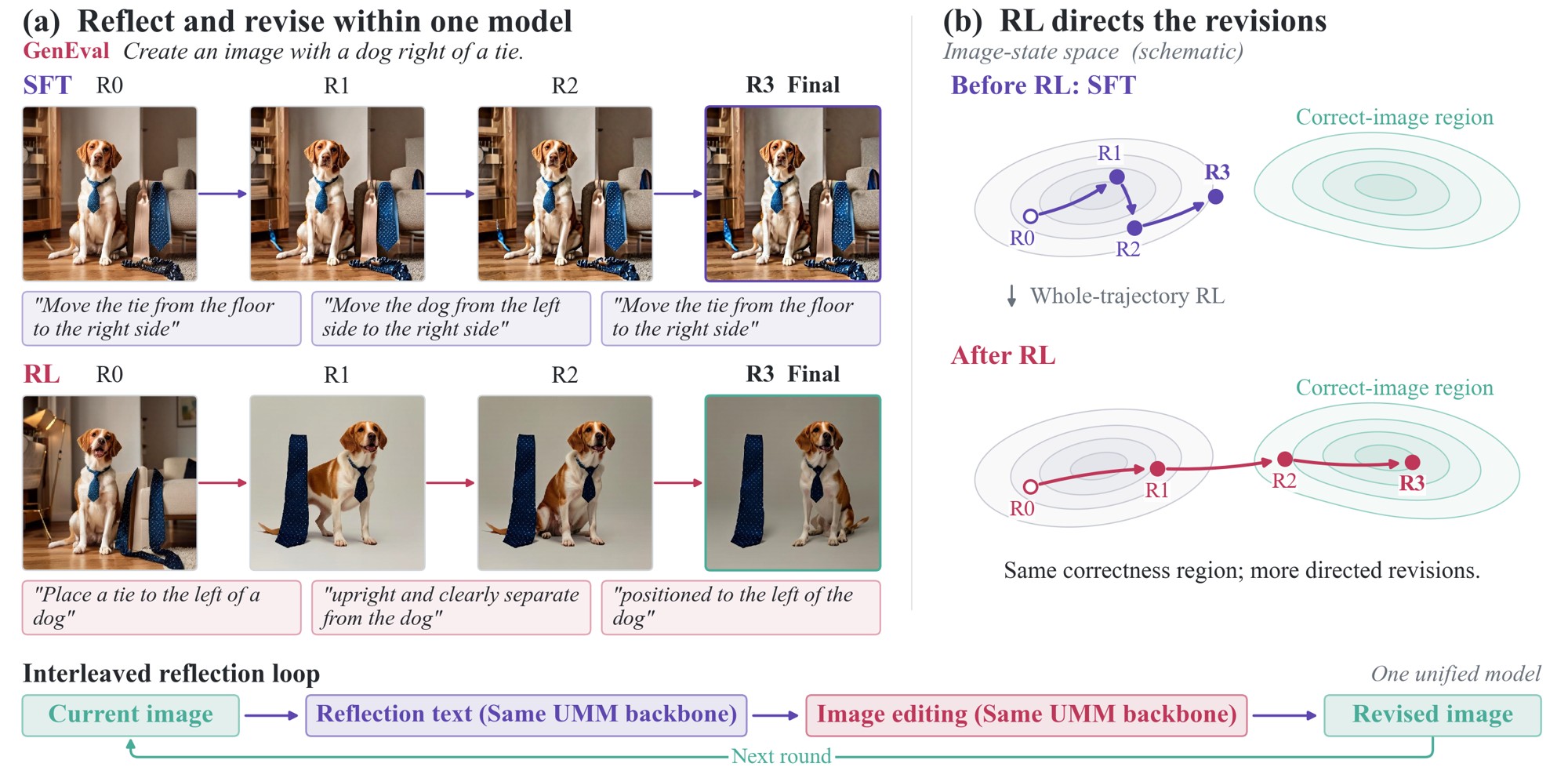
Unified multimodal models can both look at and render images, so in principle they can repair their own generations: diagnose what an image gets wrong, revise it, observe the result, and diagnose again. Whether a revision helps is known only after it is rendered, so the reflection text and the image generation must be learned jointly, over the whole loop. Supervised fine-tuning (SFT) on reflection trajectories gives a cold start but does not find the high-success repair paths, and naive RL that optimizes only the renderer or only one head leaves most of the gain untapped.
We introduce UMM-Reflection, which applies reinforcement learning (RL) to complete reflection trajectories inside one unified model: sibling trajectories share one initial image, so the group-relative advantage compares reflection strategies, and one trajectory-level advantage updates both the reflection tokens and the flow-based revisions, avoiding the combinatorial blow-up of per-round credit assignment. Unlike single-round editing or pipelines with an external critic, credit flows across rounds and to both roles of the same model, and no verifier is needed at inference. On BAGEL, UMM-Reflection improves GenEval by 12.05 points over SFT, and the gains transfer to WISE (+10.97), OneIG-Bench (+3.48), and T2I-CompBench++ (+4.63), none of which is used in training.
A three-minute tour of UMM-Reflection
Reflection is only useful when it changes the image
Writing a plausible critique is easy. Turning that critique into a better image is the hard part. We compare three ways to give BAGEL a second look at its own output, each with up to three edits, on GenEval and on three benchmarks never used in RL. Numbers below each score are the change from BAGEL-Base.
BAGEL + GPT-5.5 critic
A frontier model reads each image and writes the edit instruction. BAGEL performs the edit.
The critic declared 67 of the 163 wrong first images finished at round 0.
BAGEL-SFT reflection
The model is fine-tuned on interleaved reflection trajectories and reflects on its own.
It writes reflections in the right format, but the edits rarely fix what was wrong.
UMM-Reflection
Same model and protocol, trained with whole-trajectory RL on the images its reflections produce.
Reflection and generation are trained together, so a diagnosis is rewarded only when the edit it leads to is better.
* The critic's WISE score comes from a separate GPT-4o scoring run; its change is measured against BAGEL-Base in that same run (0.58).
Reinforcement learning on whole reflection trajectories
SFT teaches the format of reflection: inspect, diagnose, write an edit, render it. It cannot tell the model which reflections actually lead to better images, because that is only known after the edit is drawn. RL closes that loop. The model rolls out complete reflection trajectories, a verifier scores the images they produce, and the outcome is credited to both the words and the pixels that led to it.
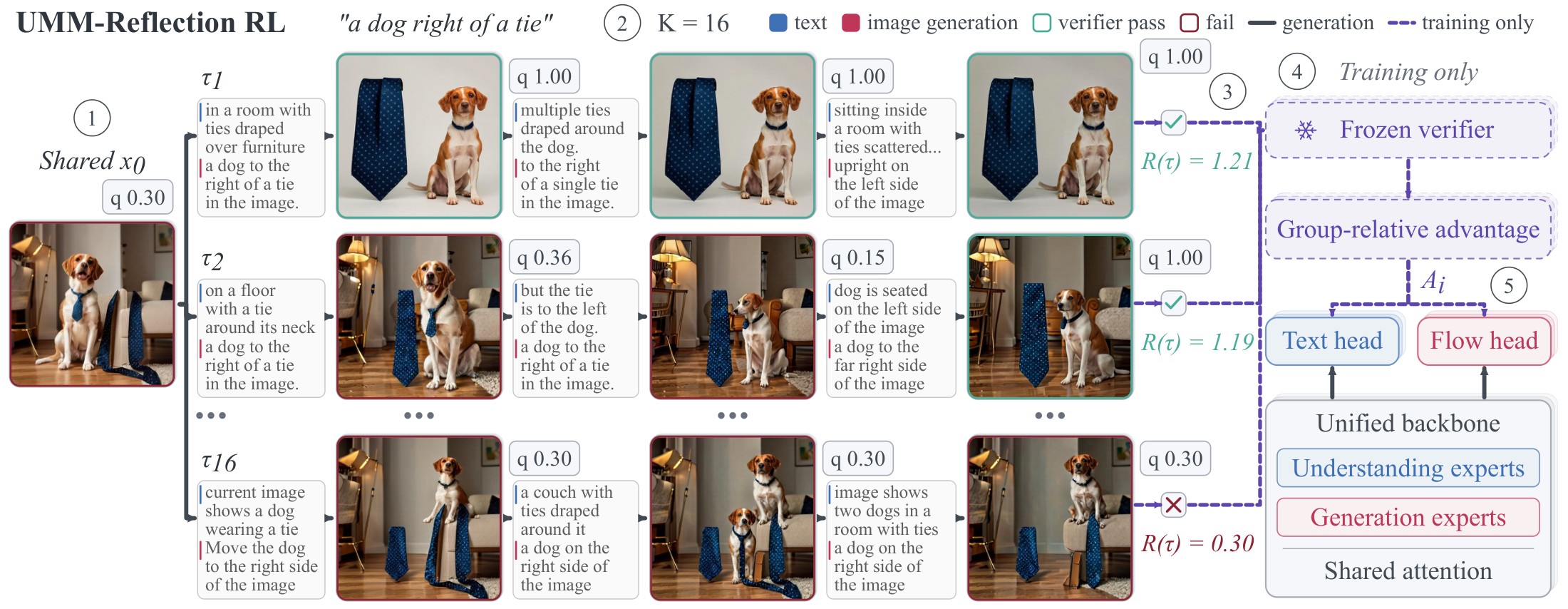
Image scores along each trajectory
Verifier scores q for the first image and the three revisions of the rollouts in the figure. Green bars pass the verifier.
How the trajectory reward is assembled
R(τ) = qT + α Σ[Δt]+ + β Smulti − λ Σ[−Δt]+ − p·1[premature DONE], with α = β = 0.3 and λ = p = 0.5.
One group of sixteen rollouts, ranked by reward
Illustrative groupAll sixteen rollouts start from the same first image (q = 0.30). τ₁, τ₂ and τ₁₆ are the rollouts in the figure; the other thirteen are constructed to show each reward term at work: steady progress, a partial fix, damage after a pass, and stopping with DONE before the image passes. The advantage is Ai = clip((R − μ) / max(σ, 0.1), −1, 1). Select a row to see its reward breakdown above.
Why one advantage per trajectory
A group-relative estimate for every round would need sibling groups at every round: branching 16 ways at each of three rounds is 16³ = 4,096 rollouts per prompt. The trajectory-level advantage keeps the 16-sample cost of GRPO, while the progress terms in R(τ) still reward each round that improves the image.
Why text and flow share it
The text policy and the flow renderer are not normalized separately. A reflection that leads to a better image raises the advantage of both the diagnostic tokens and the rendering steps that followed, so the model learns which reflections lead to which visual outcomes.
Nothing extra at inference
The verifier and the frozen SFT reference are used only to compute rewards and KL during training. At inference only the unified model runs: it looks at its own image, writes the reflection and renders the revision.
One checkpoint, four benchmarks, three of them never seen in RL
All rows use the same prompts, resolution and scorer, with up to three reflection rounds for the models that reflect. RL trains on GenEval-style prompts only; WISE, OneIG-Bench and T2I-CompBench++ measure transfer.
All five systems at a glance
Hover or tap an axis to compare on that benchmark.
GenEval accuracy by reflection budget
Official 553 prompts and detector, 512 px. R0 is the first image; +k allows k edits.
Repair rate during RL training
Share of wrong first images that are correct after three edits, along one RL run.
| Model | GenEval | WISE | OneIG | T2I-CompBench++ |
|---|---|---|---|---|
| BAGEL-Base | 0.71 | 0.55 | 0.80 | 0.49 |
| BAGEL-SFT | 0.72+0.00 | 0.63+0.08 | 0.79−0.01 | 0.50+0.01 |
| BAGEL-Self-Agentic | 0.77+0.05 | 0.61+0.06 | 0.81+0.00 | 0.52+0.03 |
| BAGEL-T2I-RL (1k updates) | 0.76+0.04 | 0.54−0.01 | 0.80−0.01 | 0.49+0.00 |
| UMM-Reflection | 0.84+0.12 | 0.74+0.19 | 0.83+0.02 | 0.55+0.06 |
Differences are relative to BAGEL-Base. Self-Agentic runs the untuned base model through the same three inspect-and-edit rounds. T2I-RL applies 1,000 RL updates to single-shot generation, with no reflection.
Where the gain comes from
The first image barely changes. What RL changes is what happens after it: which errors get repaired, on which kinds of prompts, and which half of the model has to learn for that to work.
Sub-scores on every benchmark
Both heads must be trained
Trajectory RL with one head frozen. GenEval final accuracy and repair rate of wrong first images.
What the numbers say
Repairs, round by round
Selected prompts from all four benchmarks on which UMM-Reflection's first image fails and its final image passes. Each reflection is the model's own output, verbatim; the badge under each image is that benchmark's own verdict. Select an image to enlarge it.
Same prompt, every variant
GenEval prompts on which UMM-Reflection's final image is the only one that passes. Each column is one model's final image; the number under each name is its GenEval score. The inset in the last column is UMM-Reflection's own first image.
Badges are the official GenEval detector verdicts. BAGEL-Base generates one image; every other column is the image after three rounds.
BibTeX
@article{ummreflection2026,
  title   = {Learning Native Reflection in Unified Models
             with Interleaved Reinforcement Learning},
  author  = {Fan, Yijia and Huang, Ziqi and Cai, Zhongang and Li, Yan and
             Wen, Zimo and Yin, Wanqi and Diao, Haiwen and Liu, Ziwei},
  journal = {arXiv preprint},
  year    = {2026}
}